Case Report | DOI: https://doi.org/CCSRR-CR-26-45
Outcomes of Arthroscopic Ligamentoplasty of ACL using the Four-Strand Hamstring Technique (about 40 cases)
Abstract
This is a retrospective study of 40 cases of anterior cruciate ligament arthroscopic reconstruction using the four-strand hamstring graft, collected from Traumatology and Orthopedics at military Hospital in Marrakech, Morocco between January 2021 and January 2023.
Physical findings and functional scores were recorded before the follow-up physical examination and surgery; thus, knee radiograph have been evaluated. A six-month rehabilitation program was devised following surgery. The average age of the patients was 35 years, with a male predominance of 90%. The average Lysholm score enhanced from 60% before surgery to 87% at the time of the assessment
Introduction
Anterior cruciate ligament (ACL) injury is one of the most common injuries around knee and also poses quite a lot of controversies in the management [1]. ACL has a main role not only in the function but also as a stabilizer of the knee joint [2]. Arthroscopic reconstruction of torn ACL has become the gold standard in treating ACL tears [3] . Aim of our study is to evaluate the functional outcome of arthroscopic single bundle ACL reconstruction using quadrupled hamstring tendon (gracilis and semitendinosus autograft with endobutton as femoral fixation device and interference screw as tibial fixation device in ACL deficient knees in adults.
Materials and Methods:
This is a prospective study that was conducted in Traumatology and Orthopedics at military Hospital in Marrakech, Morocco between January 2021 and January 2023. All young and middle-aged patients presenting with unilateral knee complaints and history of trauma to the knee.Specific tests were performed for diagnosing ACL deficiency like Lachmann test, Anterior drawer test, lateral pivot shift maneuver.The International Knee Documentation 2000 Score and Lysholm and Gillquist Knee Scoring Scale [4] were used for evaluation of patients.
Results:
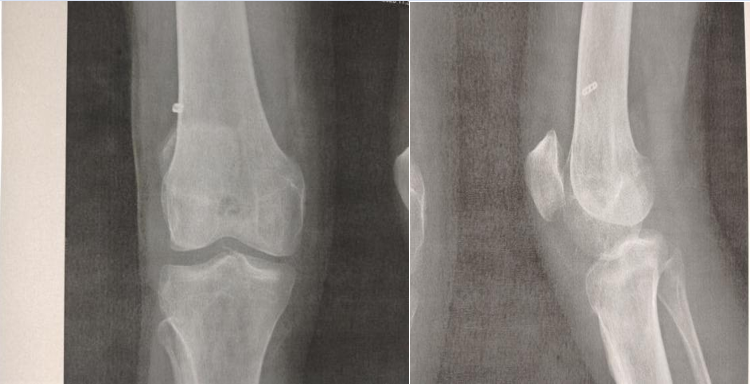
This is a retrospective study that involved 40 patients whose average age was 35 years (with extremes of 18 to 45 years) with a male predominance of 90% . The initial trauma was a sport accident in 70% of cases, a road accident in 20% and a work accident in 10% . The mechanism of injury frequently encountered was a flexion external rotation valgus in 40.7% of cases The left knee was still the most affected (60%). Subjective and objective laxity was present for all patients with a positive Lachmann and anterior drawer test for all patients MRI showed total interstitial ACL rupture in all patients, associated with meniscal lesions for 10 patients, he femoral fixation (fig 01) was made by an endobutton, in the tibial the fixation was ensured by an absorbable interference screw. The mean overall preoperative score according to Lysholm fell from 66.5 to 87 postoperatively. With an average follow-up of 24 months, the overall results were evaluated according to the IKDC score, they were excellent and good in 87% of cases. with a satisfactory reduction in pain and a resumption of usual sports activity 9 months after surgery. 40% of our sports patients have recovered to a level similar to that before the trauma. No immediate postoperative complications were noted to our patients.

Discussion:
Anterior Cruciate Ligament injuries have become very common amongst sportsmen and people sustaining road traffic accidents necessitating surgical corrections [4] . Arthroscopic ACL reconstruction have become the gold standard treatment of choice for injured ACL and is being extensively studies Arthroscopy has undeniable advantages, in fact it allows: a complete joint assessment, diagnosis and treatment of meniscal and osteo-chondral lesions at the same time of operation, better visualization of the transplant insertion areas, more high speed of postoperative and recovery [5] .The choice of the graft and implant has been a matter of great debate and the wide range of options to choose from, does not make it easy for surgeons [6] . Bone – tendon- bone graft, hamstring graft, quadriceps graft, peroneus longus graft, various synthetic grafts are options available for grafting [7] .The choice of fixation of ACL reconstruction is still evolving and the current fixation device which has been widely used were endo button and bio composite interference screws which has helped to render an improved rehabilitation program post operatively [8] .
Functional outcome: the mean post-operative Lysholm score improved from pre-operative score of 45.56 to 86.56 in our study.Fareed et al, [8.9] reported the results of a retrospective study on patients who underwent arthroscopic ACL reconstruction. The average follow up was 25.4 months. A satisfactory outcome was seen in 96%
Complications: Judd et al, [9] reported that hamstring grafts were associated with the higher incidence of infection.However, none of our patients had any form of infections
Conclusion
From this study, we conclude that ACL injuries are common in younger age group individuals. Sports injuries are the most common modes of injury followed by road traffic accidents and other causes. Arthroscopy assisted ACL reconstruction using hamstring tendon auto graft provides a stable knee, reduces post-operative morbidity and enables early rehabilitation.
References
-
A prospective study of functional outcome of ACL reconstruction with quadrupled semitendinosus tendon autograft using Endobutton and bioabsorbable interference screw [Internet]. [cited 2024 Apr 19]. Available from:https://www.researchgate.net/publication/326545868_A_prospective_study_of_functional_outcome_of_ACL_reconstruction_with_quadrupled_semitendinosus_tendon_autograft_using_Endobutton_and_bioabsorbable_interference_screw
View at Publisher | View at Google Scholar -
Ranjan R, Kumar R, Singh A. Arthroscopic reconstruction of anterior cruciate Ligament injury with autogenous hamstring graft and functional recovery of the patients. Int J Orthop Sci [Internet]. 2018 Jan 1 [cited 2024 Apr 19];4(1a). Available from: https://scholar.archive.org/work/e5vpuemnrbb5nnzxzlo2rw wzxe
View at Publisher | View at Google Scholar -
Vaishya R, Okwuchukwu MC, Agarwal AK, Vijay V. Does anterior cruciate ligament reconstruction prevent or initiate knee osteoarthritis?-A critical review. J Arthrosc Jt Surg. 2019;6:133-6.[CrossRef] [Google Scholar]
View at Publisher | View at Google Scholar -
Gudas R, Rimkunas A, Staškunas M. Large-diameter anterior cruciate ligament reconstruction technique with 8-strand semitendinosus and gracilis graft. Arthrosc Tech. 2021;10:e981-6.[CrossRef] [PubMed] [Google Scholar]
View at Publisher | View at Google Scholar -
Hagen MS, Sorey W, Kahsai E, Telfer S, Chin K, Kweon CY, et al. Anterior cruciate ligament reconstruction with 4-strand hamstring tendon construct may be biomechanically superior to 5-strand hamstring tendon construct when using femoral suspensory fixation. Arthrosc Sports Med Rehabil. 2022;4:e1097-102. [CrossRef] [PubMed] [Google Scholar]
View at Publisher | View at Google Scholar -
Singh K, Singh V. Outcome assessment after anterior cruciate ligament reconstruction among non-athletes. Int J Contemp Med Res. 2020;7:J1-5.
View at Publisher | View at Google Scholar -
Ohori T, Mae T, Shino K, Tachibana Y, Yoshikawa H, Nakata K: Tibial tunnel enlargement after anatomic anterior cruciate ligament reconstruction with a bone-patellar tendon-bone graft. Part 2: factors related to the tibial tunnel enlargement. J Orthop Sci. 2020, 25:279-84. 10.1016/j.jos.2019.03.016
View at Publisher | View at Google Scholar -
Smith PA, Cook CS, Bley JA: All-inside quadrupled semitendinosus autograft shows stability equivalent to patellar tendon autograft anterior cruciate ligament reconstruction: randomized controlled trial in athletes 24 years or younger. Arthroscopy. 2020, 36:1629-46. 10.1016/j.arthro.2020.01.048
View at Publisher | View at Google Scholar -
Aune AK, Holm I, Risberg MA. Four-strand hamstring tendon autograft compared with patellar tendon-bone autograft for anterior cruciate ligament reconstruction: A randomized study with two-year follow-up. Am J Sports Med 2017;29:722-8. [Google Scholar]
View at Publisher | View at Google Scholar